The complete guide to visiting Akagera National Park
Rwanda's Eastern Province is anchored by Akagera — the country's only savannah park, home to the Big Five since black rhinos returned in 2017. This is a practical guide from the doorstep of the park: when to go, what it costs, how to get there, and where to stay if the in-park lodges are outside your budget.
Where is Akagera National Park?
Akagera sits along Rwanda's north-eastern border with Tanzania, in the Eastern Province. The park's main visitor entrance — the Kiyonza gate — is roughly 110 km east of Kigali on the Kigali–Kayonza– Rusumo road. The last town before the park is Kayonza, which is where most self- drivers and budget-conscious groups stay overnight.
How to get to Akagera from Kigali
By private transfer: the smoothest option. Any Kigali tour operator will arrange a car and driver for USD 80–120 one-way. Journey time is 1h 30m in normal traffic.
Self-drive: the road is fully sealed from Kigali to the park. A saloon car reaches the gate fine; you'll want a 4×4 for the internal park roads, especially in the southern loop and after rain. International rentals are available from Kigali airport and the city centre.
By public bus: several bus operators run Kigali → Kayonza roughly every hour. It's the cheapest option (RWF 2,500–3,500) but you'll need to arrange onward transport from Kayonza town to the park gate. Most accommodations in Kayonza — including us — can help organise a taxi for the last 20 km.
When to visit Akagera
Rwanda has two rainy seasons and two dry seasons. For wildlife viewing, the two dry seasons are strongly preferred — animals concentrate around water sources and the roads are firm.
- Long dry season (June – September): the best time overall. Cool mornings, warm days, minimal rain, excellent visibility. Peak international visitor season.
- Short dry season (December – February): hotter but still excellent for game drives. Fewer crowds than June–September. Our personal favourite.
- Long rains (March – May): lush and green but roads can be tricky. Bird watching is exceptional. Fewer visitors, lower prices.
- Short rains (October – November): intermittent showers, still very good for wildlife. Low-shoulder pricing at most lodges.
Entry fees and safari costs
Akagera is managed by African Parks in partnership with the Rwanda Development Board. Fees change seasonally — always confirm current rates on the official park site before booking. As a rough guide for 2026:
- Park entry: USD 50 per non-resident adult, USD 30 for East African residents, RWF 5,000 for Rwandans
- Guided game drive (park guide, half-day): from USD 40 per group
- Boat safari on Lake Ihema: from USD 40 per person
- Behind-the-scenes rhino-tracking experience: USD 200+ per person (limited spots, book weeks ahead)
Budget travellers should assume USD 100–150 per person for a full day in the park (fees + a shared guided drive + lunch). Splitting a private guide across 3–4 people brings the per-head cost down significantly.
What you'll see
Since the reintroduction of lions (2015) and rhinos (2017), Akagera is one of only two Big Five parks in Rwanda (the other being Volcanoes for gorillas, though rhinos there are absent). On a good day you can expect: elephants, giraffes, zebras, buffalos, hippos, crocodiles, impala, topi, and upwards of 500 bird species. Lions and rhinos are shy and season-dependent — a licensed guide significantly improves your chances of spotting them.
Where to stay when visiting Akagera
You have three broad options:
- Inside the park: Magashi Camp (Wilderness Safaris), Ruzizi Tented Lodge, and Karenge Bush Camp offer immersive, high-end experiences from USD 400+ per person per night.
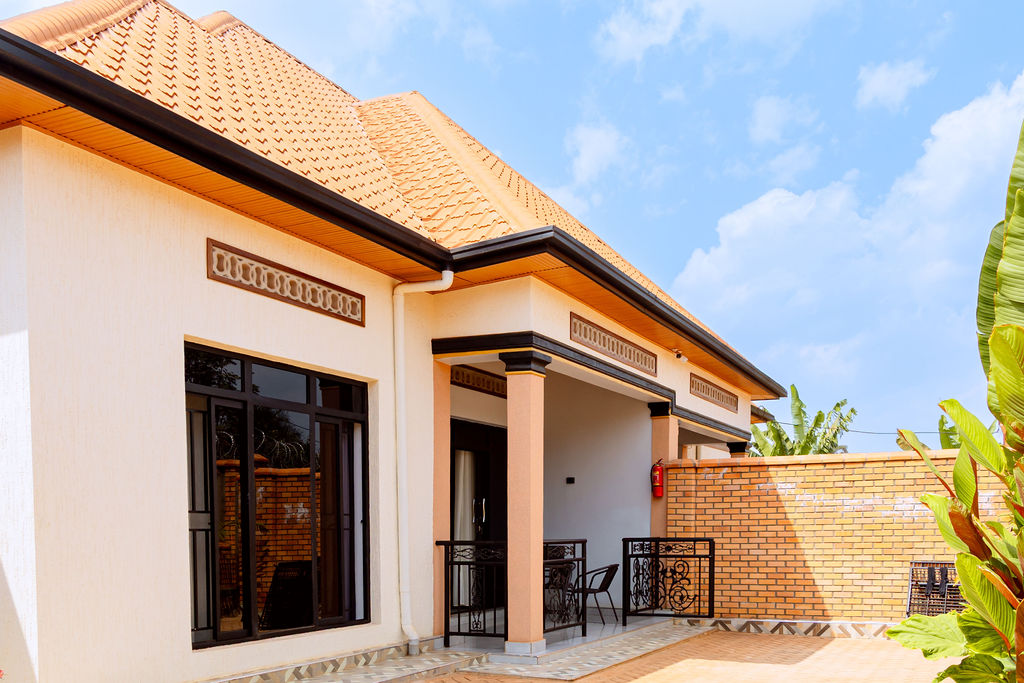
- In Kayonza town (20 min from the gate): our own Umugano Cottage and a handful of family-run guesthouses. Boutique cottages RWF 50,000–120,000; simple guesthouses RWF 20,000–40,000.
- Along the Kayonza–Kibungo road: a few mid-range hotels aimed at business travellers, useful in a pinch.
For most travellers on a Rwanda-only itinerary, staying in Kayonza and doing 1–2 game drives is the practical sweet spot — you get the safari experience without the flagship-lodge price tag.
Base yourself 20 minutes from the gate
Umugano Cottage is a boutique bamboo retreat in Kayonza — the calmest, closest place to sleep after a game drive.
See our cottages →Practical questions
How long should I spend at Akagera?
Two full days is ideal — one morning game drive, one boat safari, one afternoon drive. If you only have a day, do one full-day drive with a licensed guide who knows where the lions have been active.
Is Akagera safe?
Yes. Rwanda is one of the safest countries in Africa for tourists, and the park is professionally managed by African Parks. Standard game-drive rules apply: stay in your vehicle, follow your guide, and don't feed wildlife.
What should I pack?
Neutral-coloured clothes, a light fleece for morning drives (cool at high altitude), a wide-brim hat, high SPF sunscreen, binoculars, and a camera with at least a 200mm lens if you have one. Malaria prophylaxis is recommended — check with your doctor before the trip.
Can I combine Akagera with Volcanoes or Nyungwe?
Absolutely — and it's the classic Rwanda-in-a-week itinerary. Akagera (Eastern) → Nyungwe (South-West, chimpanzees) → Volcanoes (North-West, gorillas). Reserve at least 8–10 days total, more if you can.
Is Akagera good for families with young children?
Yes — the park is well-organised and game drives are typically 3–5 hours, manageable for children over 6. Under-6s may be limited from some experiences (rhino tracking, for example). Our Family Cottage is set up for families.